|
Vehicle description:
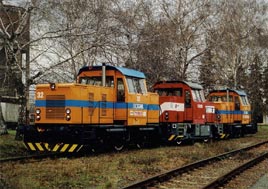
The first upgrades of 710 class locomotives to the 711 class were carried out at ČMKS-JLS back in 1997. The basic principle of the upgrade is a fundamental change in power transmission and the replacement of the most of the main vehicle parts with new components. A key feature of the upgraded locomotive is the installation of a Caterpillar 3406 DI-TA engine. The first upgraded locomotives were named the 711.7 class. In connection with the supply of two 711 class locomotives to EKO Stahl (D), which had several specific technical requirements regarding the locomotive’s specification, a decision was made to give this vehicle type a new ID: the 711.8 class locomotive.
The basic version of the 711.8 class differs little from the 711.7 class. The bogie assembly has the same design. The 711.8 is a cab-behind-engine locomotive with a single turret cab containing two driver’s posts located diagonally. A key operational safety feature is the forward-sloping front windshields, which significantly reduce glare. The cab is UIC 651 and TNŽ 28 5201 compliant. A motor generator, cooling unit and auxiliary drives are mounted in the forward, longer, hood. A pneumatic braking block, switchboard, EDB block and traction motor are located in the rear hood. The fuel tank features a new type of elastic mounting.
The LOCAT 3406/351 drive unit consists of a 365 kW Caterpillar 3406 DI-TA diesel engine and a Siemens Drásov 1FC2 351-4-611 traction alternator. Via a rectifier the traction alternator powers a TE 005 traction motor, from which a mechanical downward gearbox is driven via a cardan shaft. The other parts of the drive (cardan shafts and axle gearboxes) are based on the original vehicle design. The engine water is cooled by an original Caterpillar radiator mounted at the forward end of the front hood.
The 3DSK100 compressor is driven by V-belts. The air brake equipment block, switchboard + rectifier, and EDB resistor are located in the rear hood. The pneumatic brake is a DAKO-GP system with a BSE brake valve and electronic controllers for the automatic and direct-acting brake. The 350 kW EDB is designed for inclination/gradient braking.
Electric power transmission is AC/DC. Via a traction rectifier the traction alternator powers a traction motor working with full or weakened series excitation. A regulator controls the current, voltage and output limitation of the traction generator characteristics, depending on the diesel engine’s actual speed and the specified relative traction.
Two locomotives from this class – nos. 711.801-1 and 711.802-9 (registered under EKO 31 and EKO 32 with the operator) – were built and supplied for a German customer. The extra options installed on these locomotives include, for example, wheelslip and wheelslide protection, REBS flange lubrication, Theimeg EC-LO radio remote control and a SIFA driver’s safety device (hand and foot operated).
|




 News:
News: